
 History
Among many sectors, there is one on which the whole world depends, and it is crucial for the world’s new era. China comes in first place in the user list of the energy sector. India stands in 3rd place after the USA in the user list. The History of Energy started with humans, when they achieved the mastery of fire almost 1.5 million years ago. The Actual Phase of using Energy like Coal, oil, and electricity started from the 19th and 20th Centuries.
The Energy Sector in India
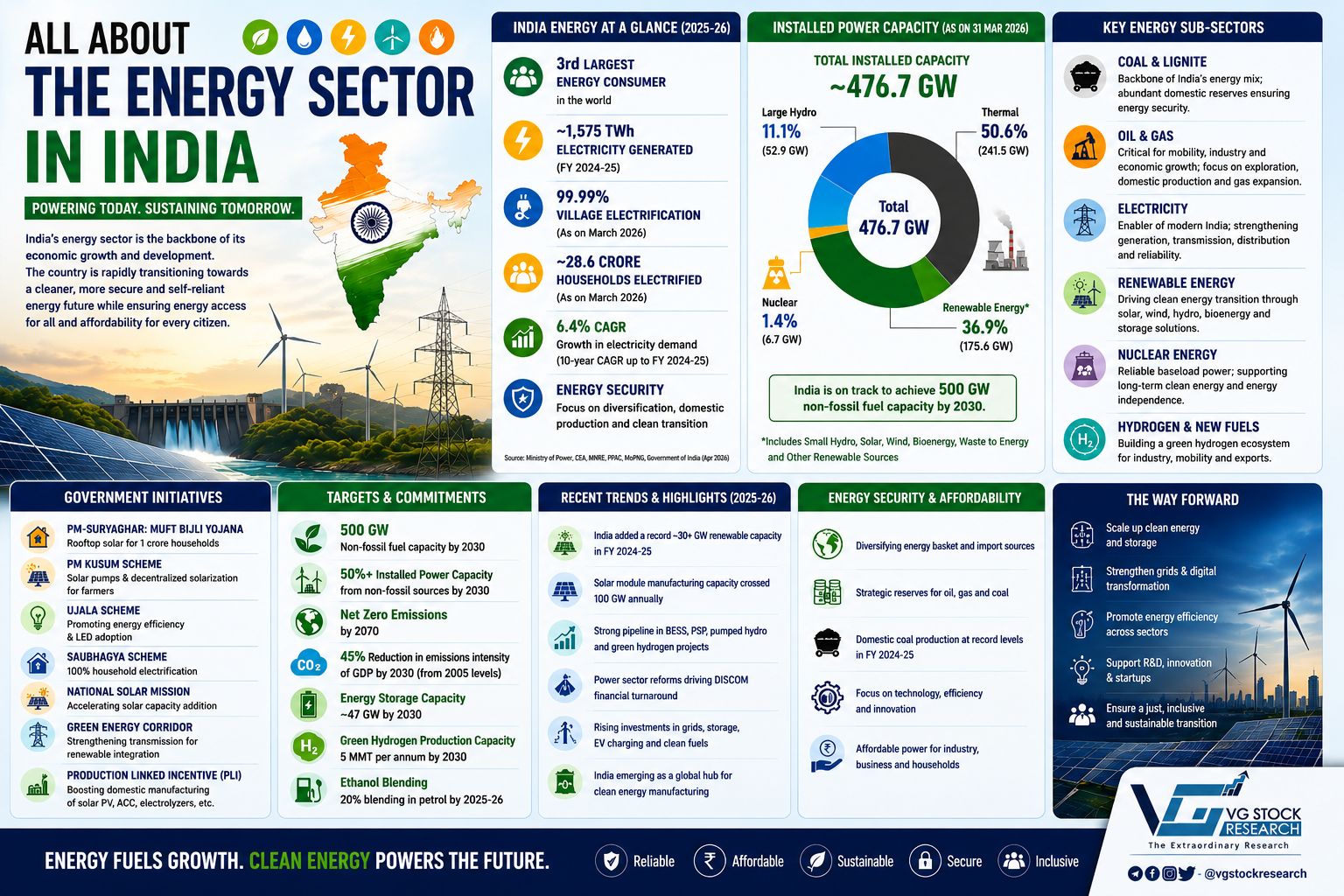
As we know, India is the 3rd largest user of the energy sector, and the demand for energy is growing 6% – 6.5% YOY Basis the projection of India’s total energy demand growth is 3520.50TWh by 2047 (EY Report). To meet this, Power Capacity is expected to reach over 2100GW, with 708 GW demand by 2047 (KPMG Blog).
In Today’s era, the energy sector is not forced with single component; there are many sub sectors comes under this sector, like Fossil Fuels (Oil, Gas, and Coal), Renewable Energy, Nuclear Energy, Utilities,
Energy Equipment & Services. The Energy sector is not a single sector; it is a group of sub-sectors, as we already mentioned to you. We elaborate on each sub-sectors with their demand, supply and reserves along with data;
Fossil Fuels (Non-Renewable)
It is a hydrocarbon-based energy source, a fossil fuel formed from the remains of ancient plants and animals that lived millions of years ago. Through a process of heat and atmospheric pressure within the Earth’s crust, these organic materials transformed into three primary forms (Coal, oil and natural gas)
Types of industries under this sub-sector
- Upstream Industry, also known as Exploration & Production (E&P), focuses on finding, drilling and extracting raw crude oil and natural gas from underground or underwater fields. As the first stage of the energy supply chain, it includes seismic surveys, exploratory drilling, and operating production wells.
- Midstream Industry serves as the critical link between upstream exploration and downstream refining, focusing on the transportation, storage and processing of crude oil, natural gas and natural gas liquids. It involves high-volume logistics using pipelines, tankers and rail, alongside storing products in tanks or underground caverns.
- Downstream Industry focusing on refining crude oil, processing natural gas and marketing of finished products. Acting as the final stage of the energy supply chain, closest to consumers. It converts raw materials into gasoline, diesel, lubricants, and plastics, with key operations including refining, distribution and retail.
Renewable Energy
Renewable Energy is the modern-day source of energy. India is the fourth largest globally in terms of installed capacity. As of late 2025, India has achieved a major milestone by sourcing over 52% its total installed power capacity from non-fossil fuel sources, reaching this COP26 goal five years ahead of the 2023 deadline (PIB).
Types of industries under this sub-sector
- Solar Power is in a rapid growth phase in India. It is ranked as the world’s third-largest producer with over 150 GW of installed solar capacity by March 2026. Supported by the MNRE and initiatives like PM-Surya Ghar, the sector is driven by low-cost production and massive projects with Rajasthan, Gujarat and Karnataka leading in capacity.
- Wind Power is the fourth largest globally with over 56 GW of installed capacity as of FY25-26. Driven by high-capacity, low-cost projects in Gujarat and Tamil Nadu, this sector achieved a record 5 GW addition in FY2026, aiming for 100 GW by 2030 through hybrid projects and 18000 MW annual manufacturing capacity.
- Hydroelectric is in its expansion phase, like other energy industries. India is the world’s 5th largest hydroelectric power. The Indian hydropower market is valued at INR 76,305 crore (nexdigm). According to NHPC, commissioning of the fourth 250 MW unit of the 2000 MW Subansiri lower project is scheduled for 08 May 2026. The industry is shifting toward massive pumped storage projects (PSPs) to balance solar/wind, with the total capacity reaching 50.7 GW in 2025 and a target of 56.6 GW
- The geothermal industry is actively being pushed by India with the newly notified national policy on geothermal energy (2025). India is to harness an estimated 10,600 MW of potential. Key developments include the resumption of drilling at the Puga Valley Project (Ladakh) and the successful commissioning of a 20 KW Pilot in Telangana in 2024.
Nuclear Energy
This Sector has shifted into an industrial expansion phase. It is the only source of non-intermittent, carbon-free baseload power capable of scaling alongside India’s growing industrial demands. India currently has 25 reactors with a total capacity of 8780 MW. It currently provides about 3% of the nation’s electricity.
Types of industries under this sub-sector
- Uranium Mining & Enrichment industry is managed by the state-owned Uranium Corporation of India (UCIL), it is rapidly expanding its domestic mining capacity in Jharkhand and Andhra Pradesh to reduce reliance on imports, which currently meet over 75% of its need s the industry, strictly controlled under the atomic energy act of 1962, uses centrifuge technology for enrichment, Primarily at the rare earth material project in Karnataka for strategic defense and fuel program
- The power generation industry is the world’s third-largest electricity producer, boasting an installed capacity exceeding 5 GW and nearly 100% household electrification. The sector is rapidly shifting toward renewable, with non-fossil sources comprising over 50% of capacity. Thermal power (Coal) remains dominant, but massive investment in solar and wind are driving India toward its 2030 sustainability goals.
Utilities
India’s utilities are the world’s third largest sector in India, with an installed capacity of 520.51 GW as of January. India’s utility sector is experiencing rapid renewable expansion (52% non-fossil) and surging electricity demand.
Types of industries under this sub-sector
- The electric utilities industry is experiencing rapid growth, with peak demand expected to reach 5 GW in 2026 and installed capacity crossing 520.5 GW. Key trends include aggressive renewable energy integration, rising thermal utilisation, and a shift toward smart metering, supported by a sharp reduction in power shortages.
- Natural Gas Utilities expands with projected growth of 60% by 2030, driven by aggressive city gas distribution (CGD) network expansion. As of early 2026, the sector is prioritising domestic piped natural gas (PNG) and compressed natural gas (CNG) Supply to households and transport amid high import prices and supply disruption
Energy Equipment & Services
This sub-sector supports and is crucial for other sectors, which is Energy Equipment & Services. EES show the rapid growth along with other energy sectors driven by a surge in power demand (250 GW in June 2025) and a massive transition toward renewables. The electricity equipment market is roughly 50 billion, supported by grid modernisation, solar expansion and manufacturing initiatives. Key sectors include solar components, switchgear, and traditional power equipment like boilers, while service firms are pivoting to digital solutions.
Types of industries under this sub-sector
- Oilfield Services market in India is projected to grow from $707 million in 2024 to over the $ 1.7 billion by 2032 with the rising domestic energy demand and increased offshore/onshore exploration. Key activities include drilling, well completion and reservoir management with top players including ONGC, Schlumberger India, Halliburton, and Asian Energy Services.
- Renewable Tech Industry in India is booming, with total installed capacity reaching 96 GW by November 2025 and solar capacity exceeding 100 GW in early 2025. Driven by aggressive government targets (520.5 GW by 2030), the industry is shifting toward domestic manufacturing through PLI Schemes, AI-driven management and energy storage solutions.
Note: The above data has been collected via media sources. Please check a reliable media source before taking any action