
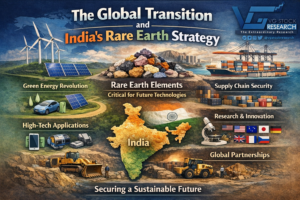
 The world has been moving rapidly over the last few decades. Technology is advancing day by day, making human work more convenient. Innovations like Artificial Intelligence (AI), Data Centers, Semiconductors, and Electric Vehicles (EVs) are replacing legacy systems and shaping a smarter future.
However, all these new-age tech devices, software infrastructure, and EVs depend on components that are exceptionally hard to find: Rare Earth Elements (REEs). This includes minerals such as Neodymium (Nd), Praseodymium (Pr), and Dysprosium (Dy). Neodymium, for instance, is essential for the high-performance magnets used in cooling systems and motors. Major global powers—including the USA, China, Russia, and India—have already accelerated mining operations within their borders to secure these vast reserves.
Global REE Reserves: Leading Nations
China currently holds the 1st position globally, possessing 44 million metric tons and a 38-48% share of the world’s total reserves.
|
Rank |
Country |
Reserves (million metric tons REO) |
Global Share (%) (approx.) |
|
1 |
China |
44 |
38-48 |
|
2 |
Brazil |
21 |
23 |
|
3 |
India |
6.9 |
7.5 |
|
4 |
Australia |
5.7 |
6 |
|
5 |
Russia |
3.8 |
4 |
|
6 |
Vietnam |
3.5 |
3.8 |
|
7 |
United States |
1.9 |
2 |
Global REE Production
China is not only the leader in reserves but also hosts the largest production facilities. It accounts for over 70% of the world’s output, producing approximately 270,000 metric tons of REO equivalent.
|
Rank |
Country |
Production (metric tons REO) |
Global Share (%) |
|
1 |
China |
270,000 |
~70 |
|
2 |
United States |
45,000 |
11.6 |
|
3 |
Myanmar |
31,000 |
~8 |
|
4 |
Australia |
13,000 |
~3.4 |
|
5 |
Nigeria |
13,000 |
~3.4 |
|
6 |
Thailand |
13,000 |
~3.4 |
Deep Dive into REE: The “Secret Sauce” of Tech
Think of rare earth elements as the “secret sauce” of the technological world. They might make up only a small fraction of a device’s mass, but their unique properties make modern innovation possible. We rely on Neodymium for powerful magnets and Europium for brilliant screens; without them, our smartphones, electric vehicles, and wind turbines simply would not function. Since these elements have no easy substitutes, they form the backbone of the green energy transition and advanced global defense.
The Emerging Market: India
India is fundamentally reshaping its REE sector, pivoting from basic state-led extraction to a high-tech, integrated value chain. This shift is a cornerstone of the nation’s industrial policy, aimed at securing minerals vital for decarbonization and high-tech manufacturing.
Between 2024 and 2026, the legislative landscape was transformed through the National Critical Mineral Mission (NCMM), the SHANTI Act, and aggressive incentive programs for downstream products like permanent magnets.
REE Deposits in India: State-Wise Distribution
The distribution of these minerals is concentrated along the southern and eastern coasts. While this provides a strategic advantage for maritime logistics, it also presents environmental challenges due to the presence of radioactive thorium.
|
State |
Number of Deposits |
Monazite Resources (Million Tonnes) |
In-situ Rare Earth Oxide (Eq.) (Million Tonnes) |
|
Andhra Pradesh |
24 |
3.78 |
2.08 |
|
Odisha |
12 |
3.16 |
1.74 |
|
Tamil Nadu |
50 |
2.47 |
1.36 |
|
Kerala |
35 |
1.84 |
1.01 |
|
Jharkhand |
1 |
0.21 |
0.12 |
|
West Bengal |
4 |
0.14 |
0.08 |
|
Gujarat |
2 |
0.07 |
0.04 |
|
Maharashta |
5 |
0.004 |
0.002 |
|
Total All India |
136 |
13.15 |
7.23 |
The demand for rare earth materials in India is no longer an optional industrial input; it has become the backbone of the nation’s transition to a low-carbon economy. India’s target of 500 GW of renewable energy capacity and 30% EV penetration by 2030 requires an unprecedented volume of critical minerals. Neodymium, in particular, was the largest revenue-generating product segment in 2024, accounting for over 42% of the market share.
Government Strategy on REE
The Government of India has launched a multi-pronged strategy to establish a domestic ecosystem for Rare Earth Permanent Magnets (REPMs). This initiative, highlighted in the Union Budget 2026–27 and a manufacturing scheme approved in November 2025, aims to reduce import dependence—particularly from China—and secure supply chains for EVs, renewable energy, and defense.
Rare Earth Permanent Magnet (REPM) Manufacturing Scheme
Approved in November 2025, this scheme is the cornerstone of India’s downstream strategy.
Financial Outlay: ₹7,280 crore.
Target Capacity: Creation of 6,000 MTPA (Metric Tonnes Per Annum) of integrated manufacturing capacity for sintered REPMs.
Incentive Structure: * Sales-linked Incentives: ₹6,450 crore to be disbursed over five years based on production.
Capital Subsidy: ₹750 crore allocated for setting up advanced facilities.
- Dedicated Rare Earth Corridors
The Union Budget 2026–27 introduced specific regional corridors to streamline the value chain from mining to manufacturing.
- Locations: Odisha, Kerala, Andhra Pradesh, and Tamil Nadu.
- Focus Areas: These corridors will integrate mining, processing, research, and manufacturing activities, leveraging the high monazite and rare-earth oxide (REO) deposits in these mineral-rich states.
2. Resource Potential and Exploration
India holds significant rare-earth reserves, which provide a competitive advantage:
-
Monazite Deposits: Approximately 13.15 million tonnes, containing an estimated 7.23 million tonnes of REO.
- Hard-rock Resources: 1.29 million tonnes identified in Gujarat and Rajasthan.
-
Recent Exploration: The Geological Survey of India (GSI) has identified 482.6 million tonnes of rare-earth ore resources across 34 exploration projects.
3. Strategic Objectives
-
Reducing Import Dependence: Currently, India imports 85–90% of its permanent magnets by quantity (and 60–80% by value) from China. The goal is to build a secure, indigenous supply chain.
-
Clean Energy Transition:REPMs are essential for EV motors and wind turbines, supporting India’s “Net Zero 2070” vision.
-
National Security:Secured access to magnets is vital for aerospace, precision sensors, and advanced defence equipment.
-
Viksit Bharat @2047: Positioning India as a global leader in advanced materials and manufacturing.
4.Policy Alignment
These initiatives align with the 2023 amendment to the Mines and Minerals (Development and Regulation) Act (MMDR Act), which:
-
Categorised critical minerals separately.
-
Opened exploration and mining of these minerals to private sector participation.
Source: Press Information Bureau (PIB) Release ID 2222413.
Economic Projections for the Rare Earth Element Market
The growth of the Indian REE market is driven by the rapid expansion of electric mobility and energy storage systems. Analysis indicates that neodymium and samarium will witness the fastest demand acceleration due to their roles in permanent magnets.
|
Market Metric |
2024-2025 Value |
2030-2034 Forecast |
CAGR |
|
Market Valuation (conservative) |
$40.7 Million |
$62.9 Million (2030) |
8.10% |
|
Market Valuation (aggressive) |
$56.5 Million |
$148.08 Million (2034) |
11.30% |
|
Neodymium Market Share |
42.51% |
Sustained dominance |
N/A |
|
Light Rare Earth Share |
~62% |
Projected growth |
N/A |
*Note: The above data has been collected via media sources. Please check reliable sources before taking any action