
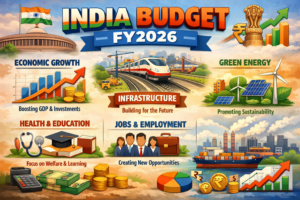
 India’s Union Budget 2026-27, presented by Finance Minister Nirmala Sitharaman on February 1, 2026, emphasises manufacturing, infrastructure, MSMEs, and fiscal prudence. Key measures aim to boost employment, exports, and sectors such as footwear, toys, and rare earths, while easing tax compliance.
Budget 2026‑-27 is positioned as a Yuva-Shakti-driven, reform-continuity budget that pushes growth, manufacturing and services while sticking to fiscal discipline. It tries to balance capex, structural reforms, and social protection with a clear medium-term consolidation path.
Big picture and macro outlook
- Vision theme: “Viksit Bharat” with action over ambivalence, reform over rhetoric, people over populism. The stated aim is growth of around 7% with moderate inflation, monetary stability, and reduced import dependence.
- Reform continuity: Over 350 reforms (GST simplification, labour codes, QCO rationalisation), more deregulation with states, and high-level committees for next-generation policy.
- Growth pillars: Sustaining economic growth, strengthening growth foundations, people-centric development, trust-based governance, ease of doing business/ease of living, and fiscal matters.
Outlook: Macros remain growth‑positive with a strong public investment push and gradual fiscal consolidation; policy is clearly pro-reform and pro-capex rather than overtly populist.
Sustaining economic growth – manufacturing, MSMEs, services
1.1 Strategic and frontier manufacturing
Key measures
- India Semiconductor Mission (ISM) 2.0 to deepen the chip ecosystem.
- Biopharma SHAKTI for advanced biopharma research and manufacturing.
- Electronics Components Manufacturing Scheme to move up the value chain.
- Integrated Programme for Textiles; dedicated schemes for container manufacturing and affordable sports goods.
- Three dedicated chemical parks, plus a scheme for rare earth permanent magnets (mining, processing, manufacturing).
- Hi-tech tool rooms in CPSEs and revival of 200 legacy industrial clusters.
Outlook: This is clearly aimed at moving India from assembly to high-value and strategic manufacturing (chips, biopharma, rare earths, chemicals), which is positive for medium‑term export competitiveness and import substitution. Execution capacity and speed of approvals will be the main risk.
Tax boosts for manufacturing
- 5‑year income‑tax exemption for non-residents supplying capital goods/equipment/tooling to toll manufacturers in bonded zones.
- Safe‑harbour and warehousing relaxations for non-residents; deferred duty payment for trusted manufacturers.
- Higher limit for duty-free inputs for seafood exports (1% → 3% of last year FOB), and extended duty-free inputs to shoe uppers.
- Longer export time (6 months → 1 year) for leather/textile garments and footwear exporters.
- BCD exemption on parts for microwave ovens, aircraft components and raw materials for aircraft‑MRO for defence units.
- One-time facility for SEZ manufacturers to sell in DTA at concessional duty.
Outlook: These incentives lower entry barriers and working‑capital pressure for exporters and capital-intensive manufacturers. Over time, they should deepen local value‑addition, especially in footwear, seafood, textiles, aviation and defence-linked supply chains.
MSMEs – “Champions” strategy
Three-pronged approach
- Equity support: ₹10,000 crore SME Growth Fund; additional ₹2,000 crore to Self‑Reliant India Fund.
- Liquidity via TReDS: Mandatory use by CPSEs, CGTMSE-backed invoice discounting, linking GeM with TReDS, and securitisation of TReDS receivables to build a secondary market.
- Professional support: “Corporate Mitras” in Tier‑II/III towns to assist MSMEs with compliance at an affordable cost.
- Export facilitation: Removal of the ₹10 lakh per‑consignment value cap on courier exports.
Outlook: Structurally positive for MSME formalisation and working‑capital access. If implemented well, this can compress receivable cycles and help MSMEs integrate better into domestic and global value chains.
1.2 Services sector focus
Key initiatives
- Medical value tourism: Support to states to build five hubs with private participation.
- Health & care ecosystem: Upgrading and new institutions for allied health professionals; NSQF-aligned programmes to train 1.5 lakh multiskilled caregivers.
- AYUSH: Three new AIIMS-style Ayurveda institutes, upgraded AYUSH pharmacies, labs, and a WHO global traditional medicine centre.
- Creative/“orange” economy: AVGC content creator labs in 15,000 schools and 500 colleges; new National Institute of Design in eastern India.
- Sports: Strengthened Khelo India Mission with a full talent‑development and sports‑science pathway
Tax reforms for services/IT
- Clubbing all IT services under one category with 15.5% safe‑harbour margin; threshold raised from ₹300 crore to ₹2,000 crore.
- Automated, rule-driven safe‑harbour approvals, five-year validity at the company’s option, and faster unilateral APAs (target 2 years + 6 months).
- Tax holidays till 2047 for foreign firms providing cloud services to global clients from India-based data centres; related entities get a 15% safe‑harbour on cost.
- Exemption of global income for non-resident experts staying up to five years under notified schemes
Outlook: Services remain India’s growth engine; these steps solidify India as an IT/cloud/knowledge hub and help diversify into medical tourism, AYUSH and creative industries. Regulatory clarity (safe harbour, APAs) should reduce litigation and improve India’s attractiveness for global captives.
-
Agriculture, allied sectors and rural
Key tax and sector measures
- Duty-free treatment for fish catch by Indian vessels in EEZ/high seas; landing at foreign ports treated as exports.
- Co-operative tax relaxations: deductions for cattle feed/cotton seed supplied by members; inter-cooperative dividend deductions; three-year dividend exemptions for notified national co-operative federations (only to the extent passed to members).
Farmer income/productivity push:
- Fisheries: Integrated development of 500 reservoirs and Amrit Sarovars, strengthened coastal value chains, start-up and women-led Fish FPO linkages.
- High‑value agriculture: Focused programmes for coconut, cashew, cocoa, horticulture; rejuvenation of old orchards and expansion of high-density walnuts, almonds, pine nuts.
- Animal husbandry: Loan-linked capital subsidy for private veterinary colleges, hospitals, labs, and breeding facilities.
- Bharat‑VISTAAR: Integration of AgriStack portals and ICAR practice packages with AI systems.
Outlook: The emphasis shifts from price-based support to productivity, value‑addition, and AI-driven advisory. This is favourable for high-value crops, fisheries and allied sectors, and should gradually support rural incomes if implementation is timely.
-
Infrastructure, energy and urbanisation
3.1 Infrastructure and logistics
Key steps:
- Infrastructure Risk Guarantee Fund for partial credit guarantees to infra lenders.
- Recycling CPSE real‑estate assets through dedicated REITs.
- New Dedicated Freight Corridor from Dankuni (East) to Surat (West).
- 20 new National Waterways linking mineral regions, industrial hubs and ports, plus a ship‑repair ecosystem for inland waterways.
- Coastal Cargo Promotion Scheme to double inland/coastal share in freight from 6% to 12% by 2047.
- Seaplane VGF Scheme for domestic manufacturing.
- ₹2 lakh crore support to states under SASCI; continued focus on Tier‑II/III city infrastructure, backed by instruments like InvITs, REITs, NIIF, NABFID.
Outlook: Very supportive of logistics efficiency and multimodal transport. Combined with higher public capex (12.2 lakh crore by FY27 vs 2 lakh crore in FY15), this underpins medium‑term growth and construction-related employment.
3.2 Energy security and climate
Measures:
- CCUS scheme with ₹20,000 crore outlay.
- Extended BCD exemption on capital goods for Li‑ion cell manufacture for battery storage systems.
- BCD exemption on sodium antimonate for solar glass manufacturing.
- Extended BCD exemption on nuclear project imports to 2035 and widened it to all nuclear plants.
- BCD exemption on capital goods for critical mineral processing; excise relief by excluding biogas value in duty on biogas‑blended CNG.
Outlook: Strong signal on long-term energy security and clean‑energy manufacturing (batteries, solar, nuclear, biogas). It should crowd‑in private capital in clean‑tech and reduce dependence on imported inputs over time.
3.3 Urbanisation – city economic regions
- Strategy to amplify city agglomeration benefits with special focus on Tier‑II/Tier‑III cities and temple towns.
- Seven high-speed rail “growth connectors”: Mumbai‑Pune, Pune‑Hyderabad, Hyderabad‑Bengaluru, Hyderabad‑Chennai, Chennai‑Bengaluru, Delhi‑Varanasi, Varanasi‑Siliguri.
Outlook: High-speed corridors plus logistics and tourism assets can reshape regional growth patterns and support real estate, services and manufacturing clusters along these routes.
-
People-centric development and the social sector
Key social initiatives:
- Care ecosystem: Training 1.5 lakh multiskilled caregivers; focus on geriatric and allied care.
- Women and SHGs: Self-Help Entrepreneur (SHE) Marts as community-owned retail outlets in cluster-level federations.
- Divyang inclusion: Divyangjan Kaushal Yojana for disability‑specific skilling; Divyang Sahara Yojana for assistive devices; support to
- ALIMCO for scaling manufacturing, and AI-enabled design; strengthening PM Divyasha Kendras.
- Mental health and emergency care: NIMHANS‑2, upgrades to institutes in Ranchi and Tezpur, emergency/trauma centres in district hospitals.
Education and tourism:
- Five university townships near major industrial/logistics corridors; girls’ hostel in every district in higher‑education STEM institutions.
- Four telescope infrastructure facilities, supporting advanced science.
- Tourism: National Destination Digital Knowledge Grid; eco‑trails (mountain, turtle, bird watching); first-ever Global Big Cat Summit; 15 archaeological sites to be developed as experiential destinations; upskilling 10,000 guides; National Institute of Hospitality.
Outlook: Social measures are targeted, with an emphasis on employability, inclusion, and linking education to industry and tourism. This supports long‑term human‑capital formation rather than short-term cash transfers.
-
Financial sector and tax administration
Financial‑sector initiatives:
- High-Level Committee on Banking for Viksit Bharat to align banking with the next growth phase.
- Incentive of ₹100 crore per issuance for municipal bonds above ₹1,000 crore (with AMRUT‑scheme continuity).
- Restructuring PFC and REC; review of FEMA (Non-debt Instruments) Rules.
- Market-making framework and total‑return swaps in corporate bonds to deepen secondary markets.
Tax changes for financial markets:
-
STT on futures raised from 0.02% to 0.05%; on options, premium and exercise to 0.15% (from 0.1% and 0.125%).
Outlook: Bond‑market reforms and municipal‑bond incentives are positive for infra financing and urban capex. Higher STT slightly raises trading costs, likely nudging flows towards longer-term positions, but may impact high-frequency/derivatives volumes.
-
Ease of doing business & ease of living – direct tax and procedural changes
Key measures for individuals and businesses:
- PROIs are allowed to invest in listed equity through the Portfolio Investment Scheme.
- Interest awarded by the Motor Accident Claims Tribunal is exempt from income tax and TDS.
- TCS on overseas tour packages, overseas education and medical remittances cut to 2% across the board.
- TDS on manpower supply fixed at 1% or 2%; automated lower/nil deduction certificates for small taxpayers.
- Depositories enabled to accept Form 15G/H across multiple holdings.
- Time for revising returns extended to 31 March (with a nominal fee); non-audit business cases/trusts allowed to file up to 31 August.
- TDS on sale of immovable property by a non-resident to be handled via the buyer’s PAN instead of TAN.
- One-time 6-month small foreign‑asset disclosure window; returns can be updated even post‑reassessment with an extra 10% tax.
- Penalty/prosecution immunity framework extended from under-reporting to misreporting; decriminalisation for non-production of books and some TDS lapses.
- Retrospective immunity (from 1.10.2024) for non‑disclosure of small foreign assets (<₹20 lakh).
- MAT reforms: MAT final tax; MAT exemption for presumptive non-residents; MAT credit set‑off up to one-fourth of new‑regime tax.
- Capital‑gains treatment for all buybacks, with additional buyback tax on promoters.
- BCD exemption on 17 cancer drugs/medicines; single digital cargo‑clearance window; Customs Integrated System (CIS) within 2 years.
Outlook: Strong tilt towards simplification, decriminalisation and dispute resolution, which should reduce compliance friction and litigation workload. The MAT and buyback changes also clarify medium-term tax treatment for corporates and investors.
-
Fiscal stance and numbers
Key fiscal metrics:
- Fiscal deficit: 4.4% of GDP in RE 2025‑26, targeted at 4.3% in BE 2026‑27.
- Debt‑to‑GDP: Target of 50±1% by 2030; estimated at 55.6% in BE 2026‑27 vs 56.1% in RE 2025‑26.
- Devolution: Vertical share to states retained at 41%, with ₹1.4 lakh crore Finance Commission grants (rural, urban, disaster management) in FY27.
Receipts and spending trends (₹ lakh crore):
|
Item |
2024‑25 Actual |
2025‑26 BE |
2025‑26 RE |
2026‑27 BE |
|
Revenue receipts |
30.4 |
34.2 |
33.4 |
35.3 |
|
Capital receipts |
16.2 |
16.4 |
16.2 |
18.1 |
|
Effective capital expenditure |
13.2 |
15.5 |
14.0 |
17.1 |
|
Revenue expenditure |
36.0 |
39.4 |
38.7 |
41.3 |
“Rupee comes from/goes to” shares:
-
Major inflows: Income tax 21%, corporation tax 18%, GST/other indirect 15%, borrowings and liabilities 24%.
-
Major outflows: Interest payments 20%, defence 11%, central sector schemes 17%, states’ share of taxes 22%.
Top spending heads (₹ crore): transport 5,98,520; defence 5,94,585; rural development 2,73,108; home affairs 2,55,234; agriculture 1,62,671; education 1,39,289; energy 1,09,029; health 1,04,599.
Outlook: The fiscal path signals credibility: capex is protected and even expanded, while deficit and debt ratios edge down. This is supportive for bond markets and sovereign ratings, and it creates space for private investment to crowd in.
Major sector allocations – 2026‑27 BE
1) Infrastructure & economic services
|
Category |
Sector / Ministry |
Allocation 2026‑27 (₹ crore) |
Comment |
|
Transport |
Transport |
5,98,520 |
Core roads, rail, other transport – largest single head. |
|
Energy |
Energy |
1,09,029 |
Power, fuels, energy transition. |
|
Urban |
Urban Development |
85,522 |
Urban infra, housing, cities. |
|
IT & Connectivity |
IT & Telecom |
74,560 |
Digital infra, telecom. |
|
Trade & Industry |
Commerce & Industry |
70,296 |
Industrial policy, export promotion. |
2) Social sectors & human development
|
Category |
Sector / Ministry |
Allocation 2026‑27 (₹ crore) |
Comment |
|
Rural & Poverty |
Rural Development |
2,73,108 |
MGNREGA, rural housing, livelihoods. |
|
Agriculture |
Agriculture & Allied Activities |
1,62,671 |
Crop, animal husbandry, allied support. |
|
Education |
Education |
1,39,289 |
School + higher education. |
|
Health |
Health |
1,04,599 |
Health services, schemes. |
|
Social Protection |
Social Welfare |
62,362 |
Vulnerable groups, welfare schemes. |
3) Security, governance & administration
|
Category |
Sector / Ministry |
Allocation 2026‑27 (₹ crore) |
Comment |
|
Defence |
Defence |
5,94,585 |
Military, defence services. |
|
Internal Security |
Home Affairs |
2,55,234 |
Police, CAPFs, internal security. |
|
Diplomacy |
External Affairs |
22,119 |
Foreign policy, missions. |
|
Core Admin |
Finance |
20,649 |
Core financial administration. |
|
Tax System |
Tax Administration |
45,500 |
Revenue administration. |
|
North East Dev. |
Dev. of North East |
6,812 |
Regional focus. |
4) Knowledge & science
|
Category |
Sector / Ministry |
Allocation 2026‑27 (₹ crore) |
Comment |
|
Science |
Scientific Departments |
55,756 |
R&D, S&T institutions. |
*Note: The above data has been collected via media sources please check reliable sources before taking any action